Review Nature Is the Artist With Chinese Scholars Stones at Art Gallery of Nsw
By John McDonald
Instead of request: "How are you?", the Chinese might greet you with words: "Have yous eaten?" If ever one required confirmation of the Chinese love of nutrient please note that the most famous and popular works in the National Palace Museum, Taipei, are ii miraculous carvings: one of a cabbage, the other a piece of cooked pork. The gift shop of the museum overfloweth with souvenir reproductions of these miniature icons.
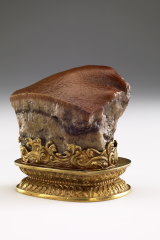
The Qing dynasty's Meat-Shaped Stone. Credit:National Palace Museum
Therefore it came as a surprise when I visited the National Palace Museum a couple of weeks ago and establish that both cabbage and meat were away on loan. Imagine the dismay of the thousands of mainland Chinese that inundation into the museum on a daily basis upon discovering its ii greatest drawcards were missing.
Prc'south loss is Sydney's proceeds because one of these morsels may be institute at the Art Gallery of NSW, in the exhibition, Heaven and Earth in Chinese Art: Treasures from the National Palace Museum, Taipei. Looking at the testify this calendar week I was surprised by the relative lack of attention being devoted to the Meat-shaped stone. A whole row of viewers had turned their backs on the tiny sculpture in social club to written report an epic scroll painting, Along the river during the Qingming Festival by Shen Yuan (1736-95).
It would be hard to draw any conclusions on the basis of i afternoon's observations, but information technology may be that local audiences are less excited by a sculptor'southward power to make stone expect exactly similar meat, than past the skill of an artist who tin sustain a landscape of near 12 metres, complete with trees, lakes, houses and hundreds of tiny figures, drawn with the utmost precision by the tip of a brush. It's the ability of invention that grabs these viewers, not verisimilitude.
Such work may sound mind-boggling but there are many items in this exhibition that brandish comparable degrees of skill, patience and inspiration. The core collection of the National Palace Museum was assembled past generations of Chinese emperors, who sought to learn the very best pieces, employing the leading artists and artisans of every age. Information technology was non until 1925, 13 years after the fall of the Qing dynasty, that a public museum was established in the Forbidden Metropolis.
Past 1933, equally the Japanese invasion closed in on the upper-case letter the collection began to exist packed up and evacuated to different locations. Eventually the works plant their way to Taiwan, where the Guomindang had retreated to escape the Communist advance. The drove has remained in Taipei since, a constant bone of contention between the island and the mainland.
It acts as a reminder of the strength and longevity of Chinese civilisation which has outlasted thousands of years of political upheavals.
Exhibitions drawn from the National Palace Museum'due south holdings have been held in the US and Europe, merely this is the showtime time a selection has been sent to Australia. The show arrives at a fourth dimension of growing tension between Red china and the Westward, merely it would be wrong to see this event equally a provocation. On the reverse, it acts every bit a reminder of the strength and longevity of Chinese culture which has outlasted thousands of years of political upheavals.
The oldest pieces in the show are a Cong tube and a Bi disc, fabricated from nephrite jade, which date dorsum to 3200-2200 BCE. The quondam is a kind of tower divided into box-like segments, the latter a smooth disc with a pigsty in the centre. These objects were used for ritual purposes only present the details of those rituals are a mystery.
The catalogue entry associates the tube with the world, and the disc with sky. This kind of symbolism is not difficult to discern, given the extensive apply of symbols throughout the history of Chinese art. Every creature, every plant, seems to be invested with symbolic significant. Those meanings rarely transcend basic concepts such every bit "longevity" or "prosperity", although a statuary mirror from the Eastern Han Dynasty (25-220 CE) contains an entire cosmology.
It'southward often said that Chinese art has been relatively static, with an exaggerated respect for the past ensuring that painters spent much of their lives copying the works of before masters. This is largely true, just at that place is too a palpable evolution that takes place over time as artists seek to extend the achievements of their predecessors, and to learn from nature.
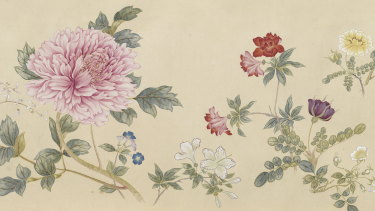
Wang Chengpei's Spring fortune collected in a brocade (detail) from the Qing dynasty 1644–1911. Credit:National Palace Museum, Taipei
The catalogue tells us about the painter and connoisseur, Dong Qichang (1555-1636), who saw his work as a "Great Synthesis" and a "dialogue with tradition". It shows in that location was always room to move if an artist was stiff-willed and dynamic in his attitudes. The history books are filled with eccentrics and mavericks who worked in styles that were looser and more expressionistic than the existing orthodoxy, in both painting and calligraphy.
1 of the glories of this show is an extensive selection of ceramics testifying to abiding change and evolution over the centuries. This is partly because of the introduction of new techniques and the increasing development of skills, only it is as well a function of changing tastes.
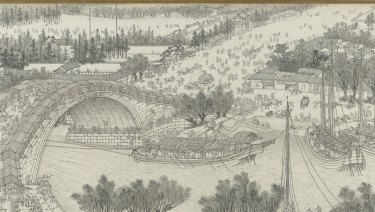
Shen Yuan'south Forth the river during the Qingming Festival' (detail) from the Qing dynasty. Credit:National Palace Museum, Taipei
Some emperors favoured more austere styles, others delighted in brightly coloured wares. The Son of Heaven was the ultimate arbiter of what was fashionable, or indeed, permitted. The Qianlong Emperor (r. 1735-96) was passionate nearly jade, calligraphy and mural painting. He wrote volumes of poesy and prose, but was as well a great burner of books who tortured and executed his critics.
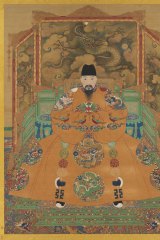
Ming dynasty "Portrait of the Hongzhi Emperor". Credit:National Palace Museum, Taipei
No matter how rigid the orthodoxies of Chinese civilization, innate talent or feeling all the same made its way to the surface. Dong Qichang may accept been an intellectual and an innovator, simply his piece of work looks academic alongside that of Tang Yin (1470-1524), whose ringlet painting, Parting at Jinchang, is 1 of the melancholy masterpieces of this exhibition.
The picture, which is accompanied past an extensive poem, depicts the departure of a well-respected administrator, following a farewell meal. Nosotros read the work from right to left, watching as the dense item of town, mountains and landscape gives fashion to the void of the lake. The swell man stands alone on the brink of that emptiness, looking back at the world he is leaving and the friends who have come to say goodbye. We tin sympathise with his mood every bit the barren copse and tiresome tones convey sadness at the moment of departing.
Heaven and Earth in Chinese Art: Treasures from the National Palace Museum, Taipei is at the Art Gallery of NSW until May 5.
christensentorned.blogspot.com
Source: https://www.smh.com.au/entertainment/art-and-design/review-heaven-and-earth-in-chinese-art-at-the-art-gallery-of-nsw-20190218-p50yhy.html
0 Response to "Review Nature Is the Artist With Chinese Scholars Stones at Art Gallery of Nsw"
ارسال یک نظر